)
)
“Good lighting is invisible”: how Sensio is helping shape the InstallerSHOW Haus
When visitors walk through the InstallerSHOW Haus this June, Sensio’s Jenniefer Roberts-Holt hopes they notice the lighting without really noticing it at all.
“It’s hard because my bias is obviously lighting,” says Jenniefer, marketing lead at Sensio Lighting. “I want people to think it’s a beautiful lighting scheme – but I also don’t want them to notice it. Good lighting is one of those things where you only realise how important it is when it’s wrong.”
That philosophy sits at the centre of Sensio’s contribution to the Haus project, where the company is supplying lighting throughout the property – from practical kitchen task lighting and staircase illumination to bathroom feature lighting and smart wireless controls.
For Jenniefer, the project offered a rare opportunity to show installers what a complete, real-world lighting scheme can look like outside of a showroom wall or catalogue page.

Lighting designed around how people actually live
Sensio approached the project room by room, tailoring products around how the spaces would actually function.
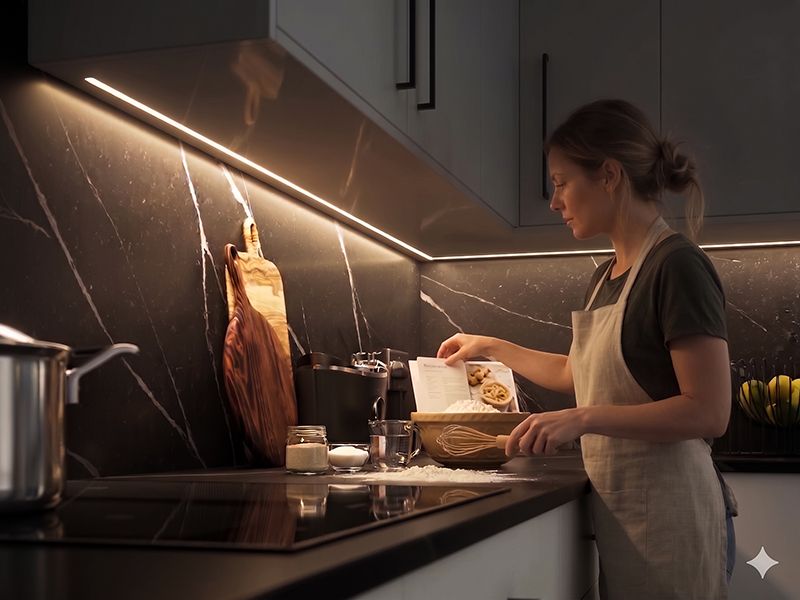
“In the kitchen, we always think in terms of task, mood and convenience lighting,” Jenniefer explains. “Task lighting is making sure you can properly see what you’re doing – chopping on a worktop for example – but then there’s also the aesthetic side.”
Material choices across the house also influenced product selection, including matching under-cabinet lighting finishes with brass kitchen handles to create a cohesive design scheme.
Elsewhere in the property, the focus shifts from decorative lighting to practicality.
“One of my favourite features is the stair lighting,” she says. “It’s very subtle strip lighting on PIR sensors, so if someone walks to the bathroom at night, the lights softly illuminate the stairs without blinding you.”
In the bathroom, meanwhile, the aim was to create a luxurious feel while complementing the house’s sustainability credentials through carefully integrated niche lighting and illuminated mirrors.
A lighting scheme designed with installers in mind
While aesthetics mattered, Jenniefer says installer practicality was equally important – particularly given the highly insulated, low-void construction methods used within the Haus.
“You can’t just chase cables everywhere in a house like this,” she explains. “So one of the biggest considerations was using wireless controls and wireless switching wherever possible.”
Sensio’s wireless and kinetic switching systems remove the need for traditional wired switching arrangements, helping simplify installation while reducing disruption within highly insulated building fabric.
“We’ve got kinetic switches that don’t need batteries, wireless sensors that pair at the touch of a button – everything is designed to make installation easier,” she says.
That installer-first approach, Jenniefer explains, comes directly from feedback gathered through regular focus groups with tradespeople.
“We regularly get installers in to tell us what they hate. They’ll say: ‘This doesn’t work, this is awkward, this takes too long.’ Then our product team uses that feedback to improve products and make installers’ jobs easier.”
Showing the end result
For Jenniefer, one of the biggest challenges in lighting specification is helping installers and homeowners visualise the finished effect.
“Lighting is really difficult to sell from a catalogue,” she says. “You can look at pages of strip lights and think, ‘What’s the difference?’ But when you see it properly integrated into a real home, it completely changes how you understand the products.”
That’s why the InstallerSHOW Haus appealed to Sensio from the outset.
“It’s about showing the end outcome,” she says. “Someone might walk through the Haus and think: ‘I want my customer’s home to feel like this.’ Then they can work backwards from there.”
Importantly, every product used in the Haus is already commercially available.
“I didn’t want people seeing products they can’t actually buy yet,” Jenniefer says. “Everything in the house is available now.”
Sustainability beyond the buzzword
Jenniefer also believes the project helps make the often-overused concept of sustainability feel more tangible for installers and homeowners alike.
“Sustainability is one of those big words everyone throws around,” she says. “But sometimes it’s difficult to show people what sustainable design actually looks like in practice.”
For Sensio, the Haus became an opportunity to demonstrate how lighting can support energy efficiency, functionality and modern living simultaneously.
Jenniefer is speaking at InstallerSHOW’s Kitchen Fitter Arena on 24th June on what to expect from the 2050 kitchen.
