
)
)
From data to market impact: Navigating the EPD journey
Environmental Product Declarations (EPDs) are becoming an important part of how construction products are evaluated and specified. As building projects increasingly measure and report embodied carbon, manufacturers are being asked to provide reliable environmental data about their products.
Producing an EPD, however, is not a single step. It is a process that typically moves through several stages — from data collection and life cycle assessment to verification, publication, and practical use in the market.
From product data to life cycle assessment
The journey usually begins with gathering detailed information about a product. Manufacturers need to compile data on raw materials, manufacturing processes, transport, and sometimes end-of-life scenarios. This information forms the basis of a product life cycle assessment (LCA), which calculates environmental impacts such as global warming potential.
To ensure consistency and comparability, EPDs in construction typically follow standards such as EN 15804 and ISO life cycle assessment standards. These frameworks define the system boundaries, indicators, and reporting format required.
Verification and publication
Once the LCA results are prepared, the EPD must be reviewed by an independent verifier. This step ensures the methodology, assumptions, and data meet the relevant standards and programme operator requirements.
After verification, the EPD is published through an EPD programme operator, making it available for designers, contractors, and sustainability consultants who need environmental data for building assessments.
From documentation to decision-making
Increasingly, EPDs are used directly in building life cycle assessments and certification schemes such as BREEAM or LEED. This means environmental product data is becoming part of the information designers rely on when modelling and comparing materials.
For manufacturers, the EPD journey therefore extends beyond producing a declaration. It also involves maintaining reliable product data, updating assessments as products change, and ensuring environmental information can be used effectively within digital design and carbon assessment workflows.
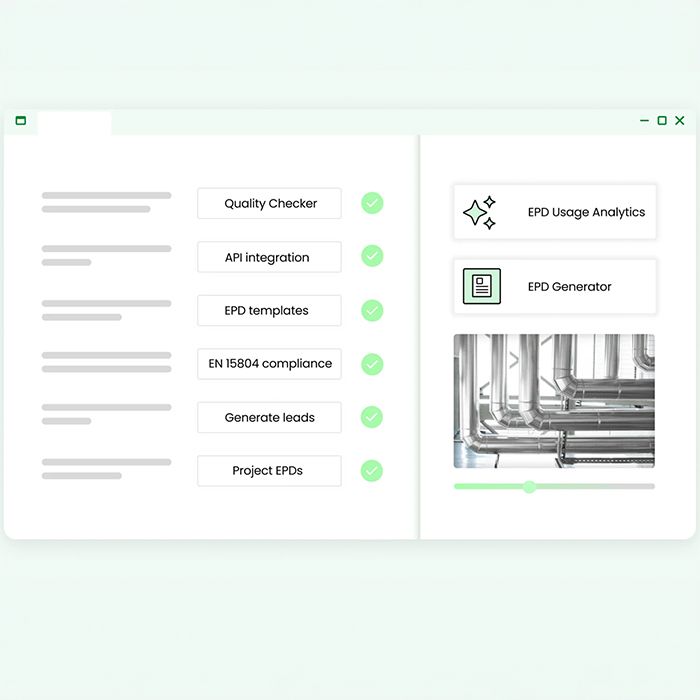
Digital tools such as One Click LCA help streamline this process by guiding manufacturers through data collection, modelling, and documentation within a single workflow. By automating calculations and standardised reporting, the platform enables companies to produce, manage, monitor, and promote EPDs more efficiently without requiring dedicated LCA specialists or large internal teams.