)
)
Rethinking the EV Foundation: The Concrete Alternative in 2026
Rethinking the Foundation: What EV Kube Means for ESG in EV Charging Infrastructure
Why the part of an EV charger nobody sees is becoming one of the most scrutinised in ESG reporting.
What is EV Kube: https://charge-m8.com/products-kube/
Introduction
ESG commitments used to stop at the charge point. Councils, CPOs and fleet operators reported on emissions avoided by drivers switching to EV, not on how the charger itself got installed. That's changing. As net zero and circular economy targets get written into procurement criteria, the materials and methods used to install charging infrastructure, right down to the foundation, are now part of the conversation.
Wet-pour and precast concrete have been the default foundation for EV chargers for years. But concrete comes with an ESG cost: carbon-intensive production, heavy plant on site, curing delays, and a foundation that's essentially unrecoverable at end of life. Charge-M8's EV Kube, a modular composite foundation built from Bulk Moulding Compound (BMC) and Dough Moulding Compound (DMC), was designed as an alternative that addresses those costs directly.
Why the Foundation Matters for ESG
A charger foundation isn't usually where sustainability teams look first, but it touches several ESG categories at once:
- Environmental – material sourcing, embodied carbon, and what happens to the foundation at end of life
- Social – installer safety and disruption to the surrounding community during installation
- Governance – whether performance and durability claims are independently verifiable, not just stated in a brochure
EV Kube was designed around all three, and Charge-M8 has published the underlying material data and third-party testing behind it, rather than treating sustainability as a marketing line.
Built From Composite, Not Concrete
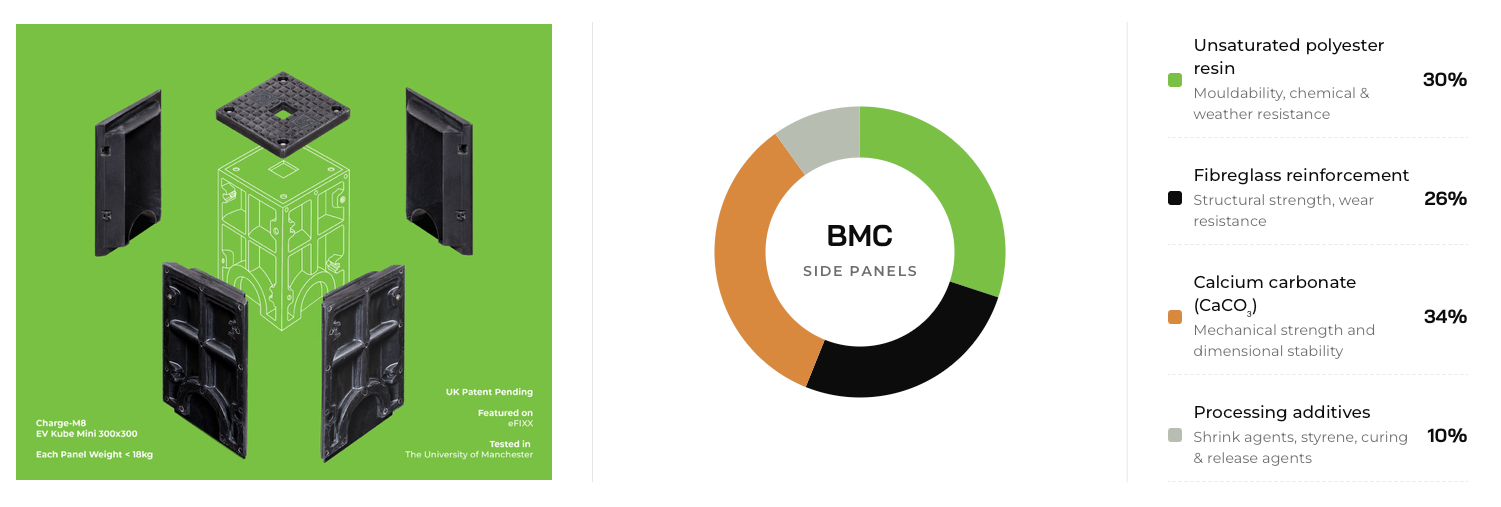
EV Kube's four side panels are moulded from BMC, and the top cover from DMC. Both are thermosetting composites, meaning they don't rely on wet-pour or curing, and they don't soften, creep or corrode outdoors over time.
The BMC composition itself is transparent:
- Unsaturated polyester resin – 30% (mouldability, chemical and weather resistance)
- Fibreglass reinforcement – 26% (structural strength, wear resistance)
- Calcium carbonate (CaCO₃) – 34% (mechanical strength, dimensional stability)
- Processing additives – 10% (shrink agents, curing and release agents)
Roughly two-thirds of that composition is inorganic and non-scarce material, which matters for anyone assessing embodied resource use rather than taking "sustainable" at face value.
Independently Verified, Not Just Described
Sustainability claims are only as credible as the evidence behind them. Charge-M8 commissioned The University of Manchester's Department of Mechanical & Aerospace Engineering to independently test EV Kube's structural performance, covering all three 470-series foundation sizes rather than the composite material category in general.
Ground stability: Overturning resistance was tested across five backfill and soil combinations at a design-speed baseline of 67 m/s. Concrete backfill with clay soil performed best, and concrete-based backfills plus the combined MOT 1 with Postcrete method showed adequate resistance across all three foundation sizes. Even the smallest, most exposed configuration held a factor of safety of approximately 1.87–1.96 in dry ground at the critical 45° incidence case. Under half-submerged groundwater conditions, that margin narrowed to 1.33–1.43, with full submersion identified as the limiting condition, which is why site-specific drainage assessment remains the installer's responsibility.
Impact resistance: All three foundation models met the IK08 rating required under BS 7671 for publicly accessible EV charging equipment, across every backfill method tested. Most configurations also met the higher IK10 rating.
Follow-up CFD study: A second, higher-fidelity computational fluid dynamics study resolved wind flow and turbulence in more detail. Its overturning demand came out lower than the first study, indicating the original assessment was conservative rather than optimistic.
Lighter Footprint, Fewer Site Impacts
Beyond the material itself, EV Kube's ESG case rests on how installation changes on site compared with concrete:
- The largest single panel weighs under 18 kg, within UK single-person manual handling guidance for the small model
- No cranes, mixing plant or curing period are required before the foundation can bear load
- Delivery is by standard courier in lightweight packages, rather than palletised concrete requiring specialist plant
Fewer vehicle movements, less heavy equipment on site and a shorter installation window all reduce a project's operational footprint, alongside the safety benefit of less manual handling risk for installers.
Circular by Design
Where concrete foundations are typically broken out and landfilled at end of life, EV Kube is designed to be recovered:
- Collection – retired units are taken back under Charge-M8's Return-to-Depot Recycling Scheme
- Mechanical recycling – BMC and DMC components are crushed and reprocessed through approved manufacturing routes
- Reintroduction – current processes allow up to 15% recycled composite content back into new production, without loss of strength
This closes the loop on a component that, under a concrete-based approach, would otherwise simply be disposed of.
What This Means for Councils, CPOs and Installers
For organisations reporting against net zero, circular economy or social value commitments, EV Kube offers a foundation choice that's easier to justify in an ESG submission: reduced reliance on concrete and heavy transport, recyclable materials backed by a manufacturer take-back scheme, durable construction with a long service life, and a lighter-touch installation that reduces both handling risk and disruption to the surrounding community.
None of this replaces a site-specific assessment. Ground heave, drainage and soil conditions still need evaluating on a per-site basis, as set out in the EV Kube Installation and Operation Manual. What EV Kube changes is the starting point: a foundation with published material data, independently tested performance, and a defined route back out of the ground at end of life.
Learn More
Full material composition, test methodology and installation comparisons are available on the EV Kube product page, along with the Frequently Asked Questions and Material Datasheet.
Interested in EV Kube for an upcoming installation? Get in touch with the Charge-M8 team to discuss your project.